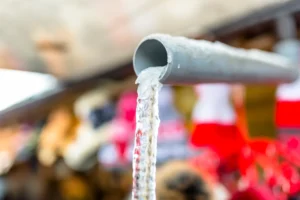
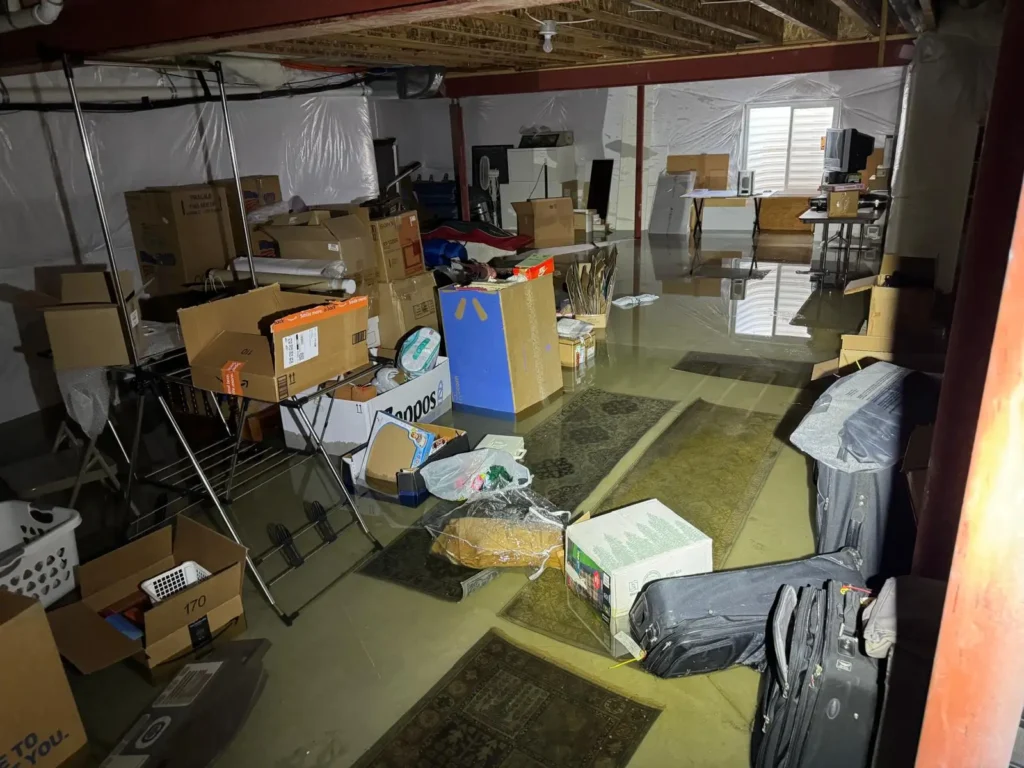
We’ve seen it hundreds of times: a homeowner discovers a burst pipe at 2 AM, with water flooding their basement, and temperatures outside at -10°F. Their first question is always, “Will my insurance cover this?”
It’s a critical question. According to a 2024 University of Colorado Boulder study analysing nearly 5,000 insurance policies, 74% of homeowners affected by disasters like the Marshall Fire were underinsured, with many covering less than 75% of their actual replacement costs. ¹ When facing thousands in water damage, knowing what your insurance covers can make the difference between full recovery and financial devastation.
As the owner of a certified water damage restoration company in Denver, I’ve guided countless homeowners through the insurance process. I’ve seen which approaches get claims approved and which mistakes lead to denials. Let me share what two decades in the restoration business have taught me about protecting your insurance claim.
| 🚨 FROZEN PIPE EMERGENCY? DON’T RISK YOUR CLAIM. We document every step for your insurance adjuster from minute one. 60-MinuteResponse Time | 24/7 Emergency Service | Denver Metro CALL NOW: 720-989-7350 |
Does Insurance Cover Burst Pipes? Understanding Your Water Damage Insurance Coverage
The short answer: usually yes—but with important exceptions.
What Standard Homeowners Insurance DOES Cover
Your standard policy typically covers frozen pipe damage if it’s “sudden and accidental”—the key phrase in most Colorado insurance policies. Here’s what’s generally included:
Quick Coverage Reference: What’s Covered vs What’s Not
| Not covered unless you have a water backup endorsement ($50-100/year) | Covered? | What You Need to Know |
|---|---|---|
| Burst pipe floods basement | ✅ | Must be “sudden and accidental” – document immediately with photos/video |
| Water damages floors/walls | ✅ | Covered under dwelling coverage – professional restoration recommended |
| Emergency water restoration | ✅ | Insurance companies prefer certified professionals (reduces their total payout) |
| Personal belongings damaged | ✅ | Furniture, electronics, clothing covered under personal property |
| Hotel stay during repairs | ✅ | Additional Living Expenses (ALE) if home uninhabitable |
| External flood from ground | ❌ | Requires separate flood insurance – standard policy won’t cover |
| Slow leak over months | ❌ | Only “sudden” damage covered – gradual leaks excluded |
| Sewer backup | ❌ | Not covered unless you have water backup endorsement ($50-100/year) |
| Poor maintenance damage | ❌ | Corroded pipes you ignored = claim denied |
| Vacant home (30+ days) | ❌ | Must maintain heat or properly winterize |
| Heat turned off | ❌ | Must maintain 55°F minimum – turning off heat voids coverage |
| ⚠️ RESTORATION COMPANY INSIGHT: Having coverage doesn’t mean your claim is automatic. We’ve seen dozens of legitimate frozen pipe insurance claims denied because homeowners started cleanup before documenting the damage. Insurance adjusters need proof of the water’s source, the extent of damage, and that you took reasonable steps to prevent it. That’s why our first action isn’t extraction—it’s documentation. |
Top 5 Reasons Insurance Companies Deny Frozen Pipe Claims
1. Negligence: Failure to Maintain Minimum Temperature
This is the #1 reason for insurance negligence frozen pipes denials in Colorado. Most homeowner’s policies contain specific language requiring you to:
- Maintain a minimum temperature of 55°F when the home is vacant
- Drain the water system if the heat will be off for extended periods
- Take “reasonable precautions” to prevent freezing
Here’s the scenario we see repeatedly: Denver homeowner goes skiing in Vail for a long weekend. To save money on heating costs, they turn the thermostat down to 50°F or even turn it off completely. Pipes freeze and burst. Insurance denies the claim, citing negligence for failing to maintainthe minimum required temperature. The homeowner is now liable for $30,000 in damage.
How to prevent this denial: Install a smart thermostat that alerts you if the home temperature drops below 55°F. Some systems even send notifications directly to your insurance company, creating documentation that you maintained proper temperature. Keep heating bills that show consistent use during the winter months. Take photos of your thermostat setting before leaving town. These simple steps provide evidence of reasonable care.
2. Lack of Proper Documentation
The insurance adjuster arrives three days after your burst pipe. Your basement is spotless—you’ve already extracted all the water, ripped out the carpet, and hauled away damaged drywall. The adjuster looks around and says, “How do I know the damage was extensive enough to justify this claim?”
You have no photos of standing water. No video of water gushing from the ceiling. No documentation of the damage extent before cleanup. The adjuster writes in their report: “Unable to verify claimed damage severity. Recommend partial payment.” Your $25,000 claim gets cut to $8,000.
How Elyon prevents this: We photograph and measure moisture levels BEFORE extracting a single drop of water. Our documentation includes: time-stamped photos of all affected areas, moisture meter readings proving water penetration depth, thermal imaging showing hidden moisture in walls, and video walkthroughs narrating the damage extent. When the adjuster arrives, we provide a complete documentation package that makes the claim undeniable.
3. Pre-Existing Conditions or Gradual Damage
Insurance adjusters are trained investigators. They look for evidence that the pipe burst was the culmination of a long-term problem you ignored rather than a truly sudden event. Red flags that trigger this denial:
- Corroded or visibly deteriorated pipes
- Water stains on ceilings or walls from previous leaks
- Mold growth that clearly predates the current incident
- Rusted water heaters, ancient plumbing, or other deferred maintenance
How to counter this: You need evidence proving the burst was sudden despite any pre-existing conditions. A plumber’s report stating “pipe failure due to extreme cold stress, not corrosion” is essential. Professional moisture readings showing damage is fresh (high moisture content, no mold growth) establish a timeline. Photos proving you maintained your home’s plumbing system—even if it’s older—demonstrate reasonable care.
4. Delayed Reporting
Colorado homeowner discovers a burst pipe on Monday but doesn’t call their insurance company until Friday because they wanted to “get estimates first” or “see how bad it really is.” The adjuster’s immediate question: “Why did you wait four days to report this? What were you hiding?”
Delayed reporting suggests you’re trying to inflate damages or that the event wasn’t truly sudden. Every day you wait gives the insurance company ammunition to question your claim’s legitimacy. Colorado insurers are particularly suspicious of claims filed more than 72 hours after the incident.
The rule: Report within 24-48 hours maximum. Most policies explicitly require “immediate” or “prompt” notification. Even if you call at 2 AM, insurance companies have 24/7 claims hotlines for exactly this reason. Get a claim number and documentation that you reported promptly.
5. Inadequate Emergency Mitigation Leading to Secondary Damage
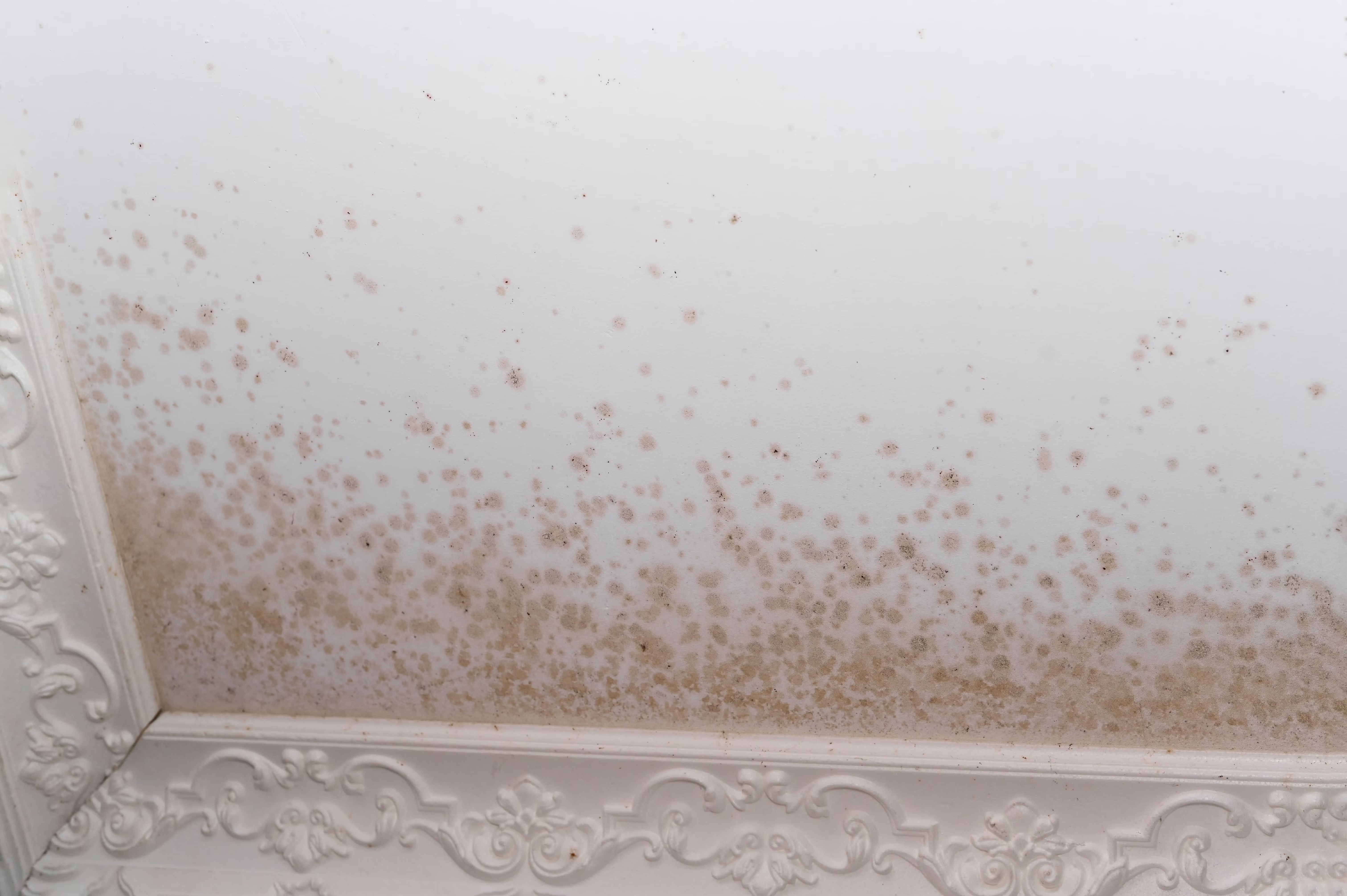
Here’s the cruelest denial scenario: Your frozen pipe insurance claim for the burst pipe gets approved, but by the time professional restoration begins (5-7 days later), mold has colonized your walls. Now the insurance company issues a second determination: “Mold damage is not covered because it resulted from inadequate mitigation, not from the original covered event.”
The homeowner is confused: “But the mold only grew because the pipe burst!” The adjuster responds: “The policy covers sudden water damage. It doesn’t cover damage that develops because you failed to dry the area properly within 24-48 hours. That’s a maintenance issue, not a covered peril.”
Now the homeowner faces: $12,000 covered water damage claim + $15,000 uncovered mold remediation = $15,000 out-of-pocket.
This is EXACTLY why you need certified restoration professionals immediately: We don’t wait for adjuster approval to begin emergency mitigation. We extract standing water, set up commercial dehumidifiers, and establish airflow within hours of your call. This prevents mold colonization and protects your entire insurance claim. The insurance company will reimburse emergency mitigation costs—but they won’t cover mold that grows because you delayed.
How to File a Frozen Pipe Insurance Claim (And Avoid Denial)
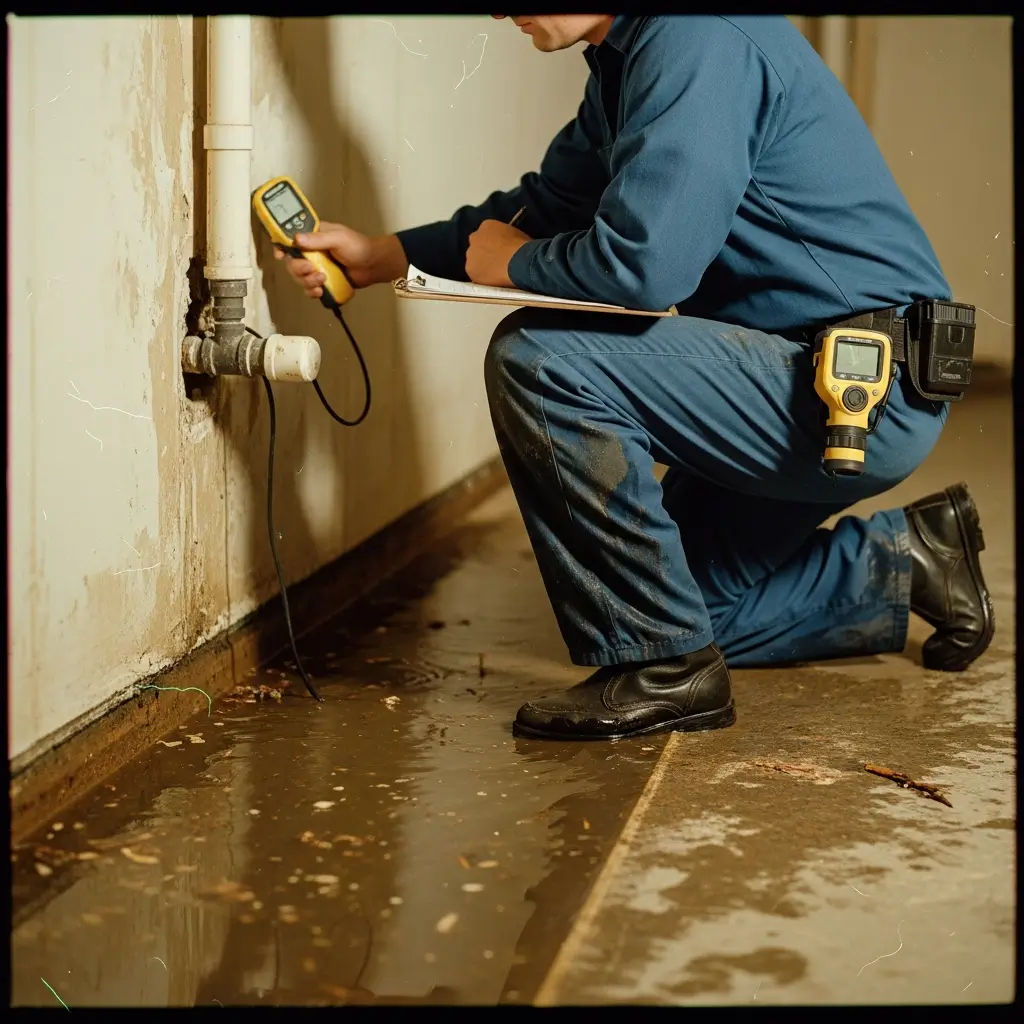
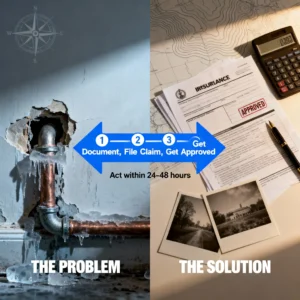
The first few hours after discovering water damage determine whether your claim gets approved or denied. Here’s your action plan:
Immediate Steps (First 60 Minutes)
1. Stop the water source – Locate and turn off your main water shut-off valve. In Denver homes, it’s typically near where the water line enters or near your meter. Can’t find it? Call a plumber immediately, while moving to step two.
2. Document EVERYTHING before touching anything – This is absolutely critical. Before cleaning up, before removing items, photograph and video everything. Capture water level, leak source, all damaged areas, and every affected item from multiple angles. More documentation means stronger claims.
Insurance adjusters look for reasons to reduce payouts. Clean up before documenting? You’ve destroyed evidence of the extent. I’ve seen claims reduced by thousands because homeowners focused on cleaning instead of documenting initial damage.
3. Contact your insurance company within 24-48 hours – Most Colorado policies require prompt notification. Call your insurer, report the claim, get a claim number, and an adjuster’s name. Save all emails, keep notes of every phone call with dates, times, and discussions.
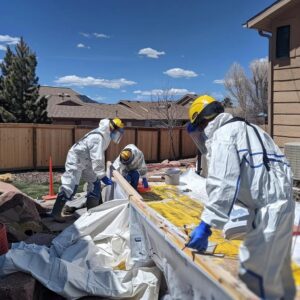
4. Call a certified water damage restoration company – This isn’t DIY territory. While you don’t have to use your insurer’s preferred vendor, you need an IICRC-certified professional. When we arrive, we bring moisture detection equipment, thermal imaging cameras, and documentation procedures that adjusters recognize and trust.
Our technicians take moisture readings throughout your home, photograph with professional equipment, and create detailed scopes matching insurance expectations. This professional documentation often means the difference between full coverage and reduced payouts.
5. Begin emergency mitigation – Your policy requires reasonable steps to prevent further damage. Remove furniture from affected areas, open windows for ventilation if the weather permits, and turn on fans. Don’t tear out materials or make permanent repairs until after the adjuster inspects.
Denver-specific note: At 5,280 feet of elevation, materials dry differently than at sea level. Lower air pressure affects evaporation rates, and our dry climate can hide moisture. DIY drying often leaves hidden moisture that adjusters detect with professional equipment—they’ll use this to minimize payouts.
| 💡 ELYON RESTORATION INSIGHT: Insurance adjusters look for evidence that you maintained your home properly. We document this proactively: photographs of your water heater date code (showing it’s not ancient), pictures of pipe insulation in your crawl space, and documentation that your furnace was functioning. When an adjuster can’t claim negligent maintenance, your frozen pipe insurance claim approval becomes straightforward. |
Timeline: What to Expect After Filing Your Water Damage Insurance Claim
Understanding the frozen pipe insurance claim timeline helps you plan—and helps you identify when something’s going wrong with your claim:
Day 1: Report the damage to your insurance company within 24-48 hours of discovery. Delayed reporting gives adjusters ammunition to question whether damage was really “sudden.” Most insurers have 24/7 claims hotlines. Call them even if it’s 3 AM.
Days 2-3: Insurance adjuster site visit. The adjuster will inspect damage, take their own photos, and ask detailed questions about what happened. They’re looking for discrepancies in your story and signs of negligence. This is why professional restoration companies coordinate our documentation with adjuster visits—we speak their language.
Days 3-5: Initial claim approval or request for additional information. Most straightforward burst pipe claims get preliminary approval quickly. If the adjuster suspects gradual damage, pre-existing conditions, or negligence, expect requests for additional documentation.
Week 2-4: Payment processing. After approval, most Colorado insurers issue payment within 2-3 weeks. For large claims ($20,000+), you might receive multiple payments: initial emergency mitigation costs, then reconstruction costs after work is completed.
| ⚠️ CRITICAL WARNING: Inadequate drying while waiting for adjuster approval creates secondary damage—specifically mold—that voids your coverage. We see this constantly: homeowners wait 5-7 days for adjuster visits while moisture saturates their walls. By day 4, mold spores colonize. Now you have two problems: original water damage (covered) and mold growth (not covered). This is exactly why emergency mitigation must start immediately, not after insurance approval. |
How Professional Water Damage Restoration Protects Your Insurance Claim
The value we provide goes far beyond drying your home—we’re protecting your financial recovery.
Why Adjusters Trust Certified Restoration Companies
Insurance adjusters are naturally skeptical. But when they see IICRC-certified company documentation, skepticism decreases significantly:
We speak their language – We use the same standards and terminology that adjusters expect. Our scopes use exact categories and processes that they recognize.
Our equipment provides objective evidence – When we say wall cavity moisture measures 28% on professional meters, adjusters know exactly what that means. Thermal imaging proving hidden water migration? Documentation they trust. Your home might “feel dry,” but our equipment proves whether it actually is—adjusters decide based on data, not feelings.
IICRC certification means standardized processes – Insurance companies prefer certified technicians following industry-standard protocols. When we say we’ve “completed structural drying per IICRC S500 standards,” adjusters know exactly what work was performed correctly.
How Elyon Restoration Maximizes Your Claim
As a local company, we’ve refined our process:
Complete damage assessment – We don’t just look at obvious damage. Thermal imaging detects water behind walls, under floors. We check areas you wouldn’t consider. Often, visible damage represents only 60% of the actual intrusion. If we don’t document everything upfront, insurance won’t pay to fix it later.
Direct insurance coordination – We communicate directly with adjusters, submitting documentation in the required format. We’ve worked with every major Colorado carrier, knowing their specific processes. This eliminates confusion and delays.
EPA-compliant methods – We follow all EPA and IICRC guidelines. When insurance sees we’ve adhered to industry standards, they have no grounds to question whether work was necessary or properly performed.
| ⚡ EMERGENCY WATER DAMAGE? WE’RE ON OUR WAY. Burst pipe? Flooded basement? Leaking water heater? Elyon Restoration’s 24/7 emergency response team is standing by. Stop the damage now. Protect your claim forever. 📞 CALL 720-989-7350 – Available 24/7/365. 💻Get a Online Water Damage FREE Estimate |
Red Flags: When to Suspect Your Frozen Pipe Claim Might Be Denied
Pay attention if your adjuster asks these repeatedly:
| “Utility bills, neighbors, mail delivery confirm.” | “Utility bills, neighbors, mail delivery confirm.” | ✅ How to Respond |
|---|---|---|
| “What was your thermostat set to?” | Did you maintain 55°F minimum required? | “Always at 68°F” (if true) – NEVER admit below 55°F |
| “How long were you away?” | Was home vacant 30+ days (exclusion)? | Be honest – emphasize heat was maintained |
| “When did you last inspect plumbing?” | Pattern of poor maintenance? | “Last inspection [date]” – show records |
| “How do you know it happened suddenly?” | Can they argue gradual leak (not covered)? | “Discovered exactly [time/date] – no prior signs” |
| “Have you had leaks before?” | History of neglect? | If yes: “Repaired immediately – have receipts” |
| “Did you make any repairs yet?” | Looking for policy violations | “Emergency mitigation only – awaiting inspection” |
| “Can you prove you were living here?” | Vacant property exclusion check | “Utility bills, neighbors, mail delivery confirm” |
How to Fight a Denial
If denied, don’t give up. Colorado provides consumer protections:
- Request a written denial with specific policy language cited
- Document timeline proving sudden damage
- Get a professional restoration company assessment
- File a formal appeal with supporting documentation
- Contact Colorado Division of Insurance: 303-894-7490 or 1-800-930-3745 (recovered $26.4 million for consumers July 2023-June 2024)
- Consider legal consultation for larger claims
Never exaggerate damage or include unaffected items. Adjusters investigate thoroughly—dishonesty can void your entire policy.
Protect Your Insurance Claim with Professional Restoration
After years of helping Denver homeowners navigate insurance, we’ve learned that understanding coverage is only step one. Getting claims approved and fully paid requires professional documentation, proper mitigation, and industry-standard procedures that adjusters recognize.
Successful recoveries aren’t about best policies—they’re about calling certified professionals immediately, documenting thoroughly, and following proper protocols from minute one.
Colorado’s climate creates unique challenges. Altitude affects drying times. Temperature swings create brutal freeze-thaw cycles. Dry air masks moisture problems, becoming mold later. These factors directly impact whether claims get approved and homes get restored properly.
DIY cleanup might seem like a money-saving option, but it typically costs far more in denied claims, inadequate drying, and secondary damage. The $1,500 saved on professional restoration can easily cost $20,000 in uncovered mold remediation six months later.
Professional documentation isn’t just paperwork—it’s protecting financial recovery. When our IICRC-certified technicians document damage with moisture meters, thermal imaging, and industry-standard protocols, we’re creating evidence your insurance needs to approve frozen pipe insurance claims without dispute.
We’ve guided thousands through this process. We know which approaches work, which lead to denials. We know local adjusters, understand Colorado’s unique challenges, and speak insurance companies’ language.
When you call Elyon Restoration for frozen pipe damage or any water emergency, you’re not just getting water extraction and drying. You’re getting claim protection. Our documentation is specifically designed to support insurance approval. Our technicians identify and document all damage—visible and hidden—before adjusters finalize estimates.
Don’t let water damage become a financial catastrophe. Professional restoration documentation delivers approved claims the first time, with full coverage for necessary repairs.
| 🌊 YOUR COMPLETE WATER DAMAGE RESTORATION SOLUTION Emergency Water Damage? Call Elyon Restoration and Abatement 24/7 📞 720-989-7350 60-Minute Emergency Response Guaranteed Available 24/7/365 for: Burst pipes | Basement flooding | Ceiling leaks | Appliance malfunctions | Storm damage | Sewage backups | Fire sprinkler discharge |