Licensed Asbestos Abatement Contractors in Denver
We work for you, not your insurance company. – Veteran-led asbestos removal across Denver and Colorado’s Front Range

What Is Asbestos Abatement and When Is It Required in Denver?
Asbestos abatement is the professional removal of asbestos-containing materials (ACMs) from buildings to eliminate health hazards and comply with Colorado safety regulations. In Denver, where the average home was built in 1987 — near the end of widespread asbestos use in construction — many properties in established neighborhoods contain materials that may harbor asbestos fibers.
Elyon Restoration and Abatement LLC provides complete asbestos abatement services across Denver and the Front Range. As a company founded by an industry veteran with over 20 years of personal experience, we hold Colorado GAC License #30367 and IICRC certification, making us one of the few Denver companies qualified to handle both asbestos abatement and full property restoration under a single contractor.
Asbestos abatement is commonly required as a result of fire, water, or other catastrophic damage that disturbs building materials in older structures. It is also required before renovation or demolition projects that impact suspect materials above Colorado’s regulatory trigger levels.
- (720) 602 6746
Common Asbestos-Containing Materials in Denver Homes
Denver homes built before the late 1980s — especially in neighborhoods like Capitol Hill, Park Hill, Washington Park, Five Points, Baker, and Congress Park — may contain asbestos in the following materials:
- Vinyl floor tiles and mastic adhesive — one of the most common ACMs in Denver homes
- Pipe wrap insulation — found on heating and plumbing pipes in basements and crawlspaces
- Spray-applied ceiling texture (popcorn ceilings) — widely used before 1980
- Sheetrock joint compound — used to finish drywall seams
- Vinyl sheet flooring — the backing layer often contains asbestos
- Roofing shingles and felt — exterior materials on older roofs
- Ductwork insulation and boiler wrap — common in homes with forced-air heating
The only way to confirm whether a material contains asbestos is through testing by a CDPHE-certified inspector. Elyon Restoration coordinates this inspection process as the first step in every abatement project.
Colorado Regulation 8 Part B: What Denver Homeowners Need to Know
Colorado’s asbestos regulations, enforced by the Colorado Department of Public Health and Environment (CDPHE) under Regulation 8 Part B, are among the most detailed in the country. Here’s what you need to know:
- Inspection requirement: A CDPHE-certified asbestos inspector must survey the property before renovation or demolition if suspect materials will be disturbed above trigger levels.
- Residential trigger levels: 32 square feet on surfaces, 50 linear feet on pipes, or the volume equivalent of a 55-gallon drum.
- 10-day notification: A written application to CDPHE is required at least 10 working days before abatement work can begin.
- GAC requirement: Only a licensed General Abatement Contractor may remove regulated asbestos-containing materials.
- Proper disposal: All ACM waste must be disposed of at a CDPHE-approved asbestos waste facility — no exceptions.
- Permit fees: CDPHE charges a flat fee of $50, plus $5 per 1,000 square feet, for abatement projects.
For a detailed guide on Denver’s asbestos regulations, read our comprehensive article: Essential Asbestos Abatement Regulations Denver Homeowners Need to Know.
Why Denver Families Trust Elyon Restoration for Asbestos Abatement
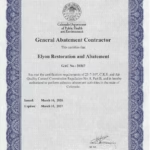
Elyon Restoration holds Colorado General Abatement Contractor License No. 30367, issued by CDPHE.
Minimizing exposure risks to protect your family and employees.
Comprehensive assessments to locate and remove asbestos safely.
Adhering to environmental standards in every removal process.
Our Asbestos Abatement Process in Denver
Every Elyon Restoration asbestos project follows a defined sequence that ensures safe removal, full regulatory compliance, and minimal disruption to your family. Here’s what to expect:
Certified Inspection Coordination
We coordinate a property inspection with a CDPHE-certified asbestos building inspector to identify all asbestos-containing materials, their location, condition, and quantity.
Containment and Safe Removal
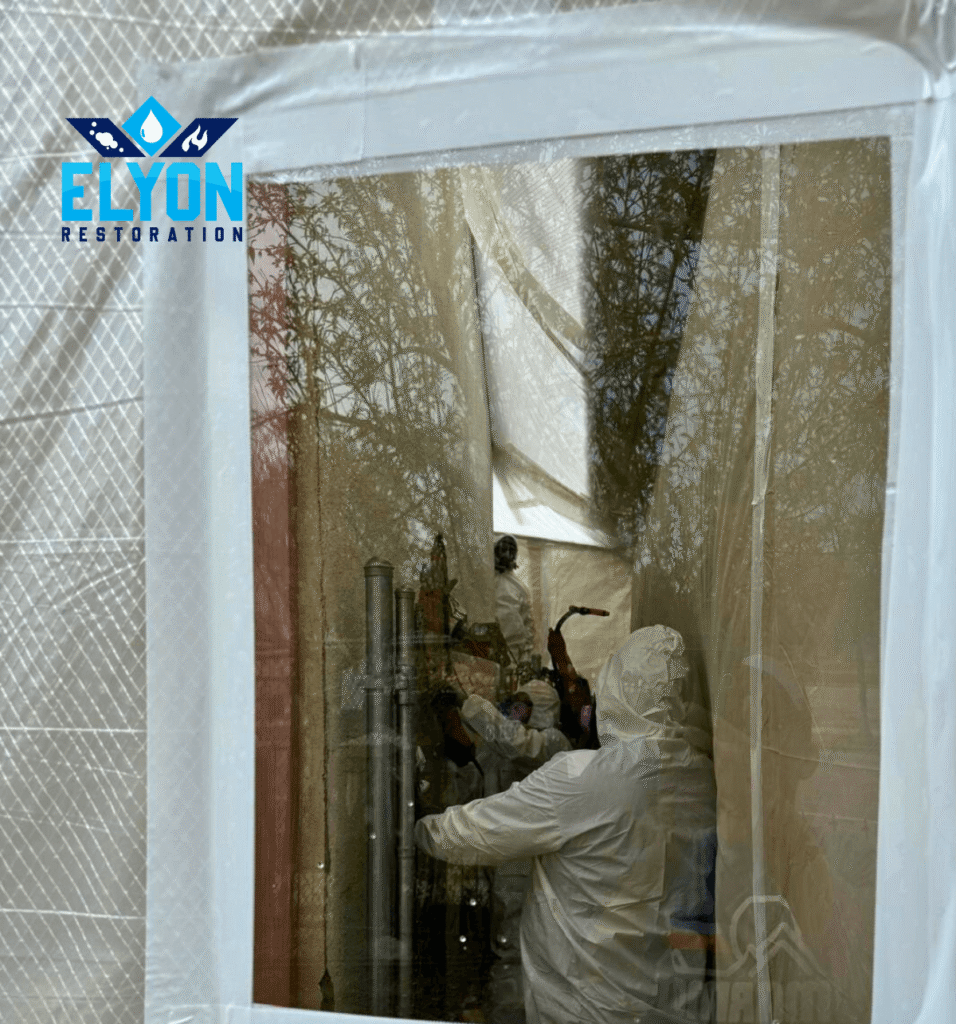
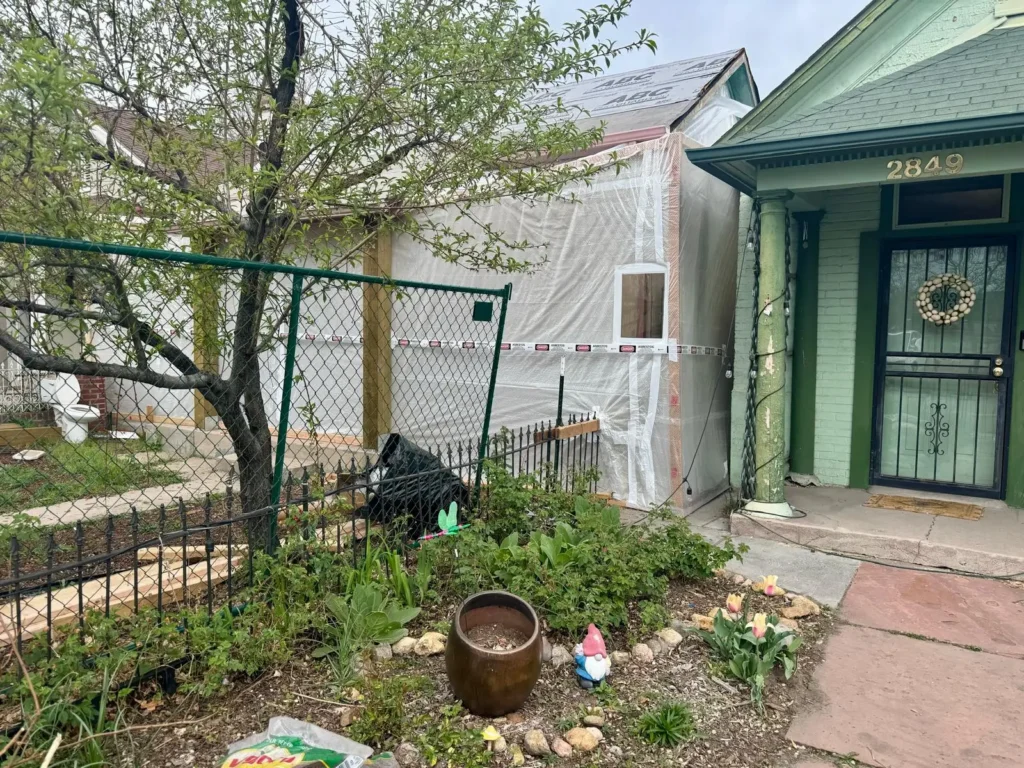
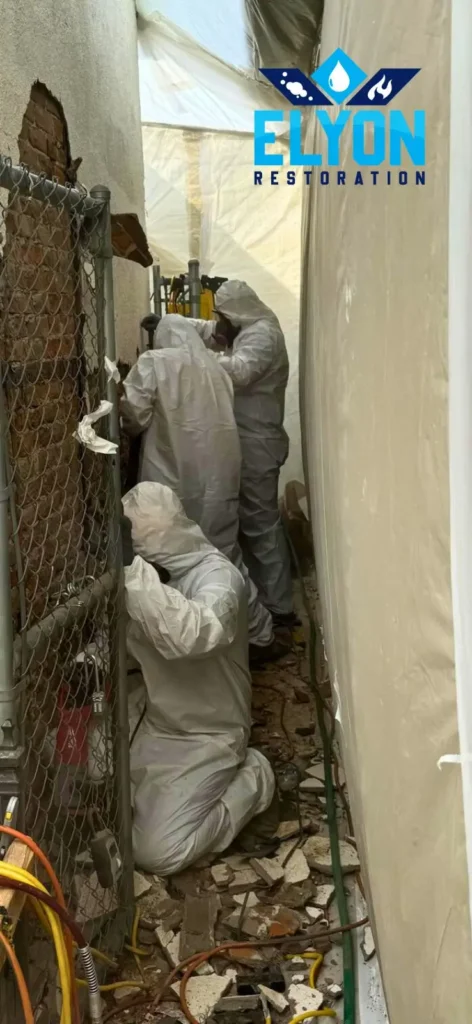
Our GAC-licensed crew sets up negative air pressure containment with HEPA filtration to prevent fiber release. We safely remove all identified ACM—including vinyl floor tile, pipe wrap, popcorn ceiling texture, and joint compound.
Air Monitoring and Clearance Testing
After removal, independent air monitoring confirms that airborne fiber levels meet safety thresholds. Only after clearance is confirmed do we release the contained area for reoccupation.
Disposal and Final Documentation
All ACM waste is transported to a CDPHE-approved asbestos waste disposal facility in compliance with Colorado Solid and Hazardous Waste Commission regulations.
How Much Does Asbestos Abatement Cost in Denver?
Asbestos abatement in Denver typically costs between $1,800 and $5,600, with whole-home or commercial projects occasionally exceeding $7,000. The primary cost factors include:
- Square footage of the affected area — larger areas require more containment and labor
- Material type — pipe wrap removal differs in complexity from floor tile or popcorn ceiling
- Accessibility — confined spaces like crawlspaces increase labor time
- CDPHE permit fees — $50 base plus $5 per 1,000 square feet
- Disposal requirements — hauling costs range from $90 to $250 depending on volume and distance to approved facility
Elyon Restoration provides free on-site estimates for all Denver and Front Range asbestos abatement projects. When your abatement is triggered by a covered insurance event (fire damage, water damage, storm damage), we work directly with your insurance carrier and advocate for your full entitled coverage.
Asbestos Abatement After Fire, Water, or Storm Damage
When fire, flooding, or severe storm damage impacts an older Denver property, building materials containing asbestos may become friable — meaning fibers can be released into the air. Colorado law requires a certified asbestos inspection before any restoration work can proceed on damaged structures that may contain ACM.
This is where Elyon Restoration offers a unique advantage: we hold both a GAC license for asbestos abatement and IICRC certification for property restoration. Instead of coordinating between separate abatement and restoration contractors — which adds weeks of delay and creates communication gaps — Elyon manages the entire project from asbestos removal through full property reconstruction.
Our integrated approach means faster timelines, cleaner handoffs, and a single point of contact for both you and your insurance company. We work for you throughout the process, not for your insurer.
Related services: Fire Damage Cleanup | Water Damage Restoration Denver | Mold Remediation
Denver Asbestos Abatement Service Areas
Elyon Restoration provides licensed asbestos abatement services throughout Denver and Colorado’s Front Range, including:
Denver Metro: Denver, Aurora, Lakewood, Centennial, Arvada, Westminster, Thornton, Broomfield, Northglenn, Greenwood Village
South Metro / Douglas County: Parker, Castle Rock, Highlands Ranch, Lone Tree, Castle Pines, Littleton, Englewood
Boulder County: Boulder, Longmont, Louisville, Lafayette, Superior, Erie
Northern Colorado: Fort Collins, Loveland, Greeley
Denver neighborhoods with the highest concentration of pre-1980s housing — and therefore the greatest likelihood of asbestos-containing materials — include Capitol Hill, Park Hill, Washington Park, Five Points, Baker, Highlands, Congress Park, Cheesman Park, and City Park.
Frequently Asked Questions About Asbestos Removal in Denver
How much does asbestos abatement cost in Denver, CO?
Do I need an asbestos inspection before renovating in Colorado?
How long does asbestos removal take in Denver?
What materials commonly contain asbestos in Denver homes?
Is asbestos removal covered by homeowners insurance?
What is a GAC license and why does it matter?
Can I remove asbestos myself in Colorado?
Protect Your Family from Asbestos Exposure Today
If you suspect asbestos in your Denver home — whether you’re planning a renovation, dealing with storm damage, or simply concerned about older building materials — don’t wait. Asbestos exposure poses serious health risks, including asbestosis, lung cancer, and mesothelioma.
Free inspection • GAC License #30367 • IICRC Certified • We work for you, not your insurance company